Watching from the Path: A Quiet Distance for Garden Birds
Choose a viewing place that leaves birds’ familiar routes open, then let their behaviour—not a fixed distance—tell you whether to stay or step back.
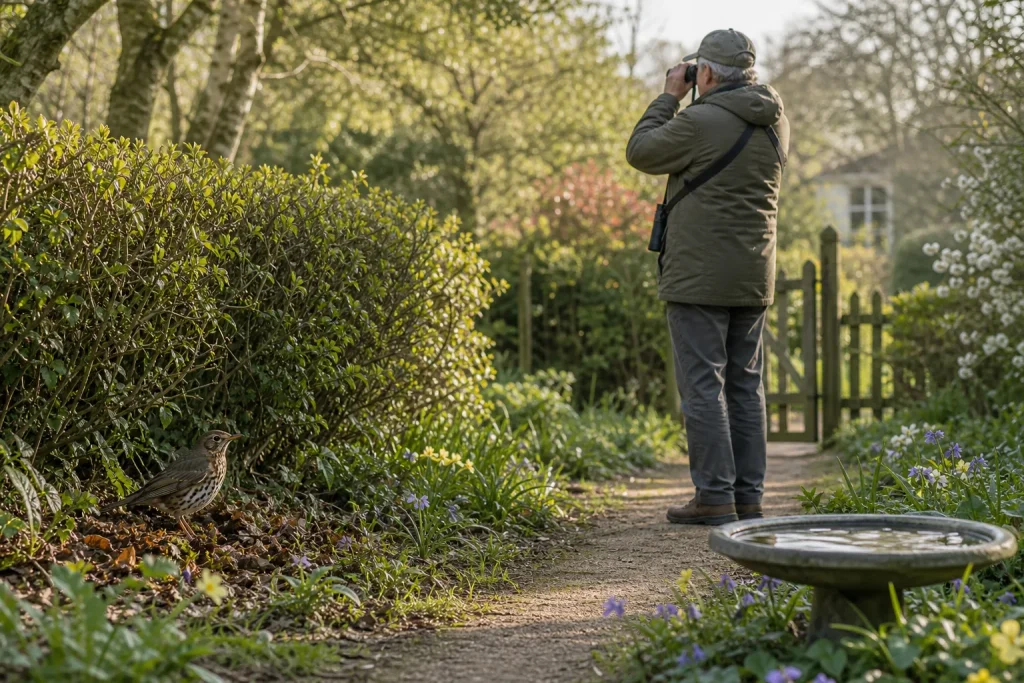
The common mistake is to edge closer for a clearer view just as a bird settles into feeding or shelter. That small approach can send it away from a useful patch of garden, and leave you watching an empty branch instead. A better field habit is to choose your place first, then let the bird’s response set the boundary.
Start with a route, not a target
Before stopping, notice how birds move between cover, food and water. A blackbird may cross an open lawn to reach leaf litter; a robin may use a low hedge as a screen. Stand to one side of those routes rather than in the gap they regularly use.
A path, gate or sheltered corner can make a natural viewing point. Keep your feet on the hard surface where possible, and avoid standing between a bird and dense cover. The aim is not to hide at any cost, but to avoid making the bird choose between its usual route and your presence.
Look for a place where you can see without leaning over a feeder or pressing against a hedge. If the view is partly blocked, accept the gap. A brief glimpse through branches is often less disruptive than stepping into the space the bird is trying to use.
Let ordinary garden activity guide your distance
Birds do not respond to a single universal viewing distance. Their comfort can depend on the individual bird, the cover available, what it is doing and how suddenly a person appears. Watch for changes rather than trying to judge a precise number of paces.
If a bird pauses feeding, turns repeatedly towards you, gives an alarm call or moves towards cover, treat that as a request for more room. Freeze briefly, then withdraw slowly along your original route. Do not follow it to regain the view; let the observation end or resume from farther away.
By contrast, a bird that continues its ordinary activity may be tolerating your presence, but that is not an invitation to move closer. Stay still and keep your movements small. The useful question is not “How near can I get?” but “Can it carry on without changing what it was doing?”
Use a steady posture and quiet equipment
Sudden movement often draws more attention than a person who has been standing quietly in the same place. Settle before raising binoculars, and lift them smoothly rather than bringing them up in a quick sweep. A neutral stance, with your body angled slightly away, can feel less confrontational than facing a bird squarely.
Choose binoculars that let you see from the path instead of relying on a phone camera’s zoom. Keep straps, zips and loose items from knocking against one another. There is no need to suppress every ordinary sound, but avoid calling birds towards you or playing recorded calls to bring them into view.
Say you are watching a song thrush near a low hedge from a garden path. It stops probing among the leaves and looks towards you. If you lower your binoculars, wait, and then step back along the path, the bird has a clear route into cover; you may lose the close view, but you have avoided pressing into its feeding space.
Keep paths and feeding places usable
Garden birds need room to reach food and shelter without being funnelled past a person. Avoid lingering directly beside a feeder, bird bath or the opening in a hedge. If another visitor arrives, shift to one side rather than holding the best viewing spot as if it were reserved.
At a shared garden, follow posted access rules and give other people room to pass. Keep dogs close and under control, and do not let them sniff around a hedge base or chase birds from a lawn. A bird that flies off may have lost access to a feeding patch or safe cover, even if it returns later.
Some details are not worth the effort: creeping closer for a sharper photograph, trying to make a bird appear on cue, or staying after it has repeatedly retreated. A field note about the bird’s route, behaviour and the weather can be more useful than a close image, and it asks less of the animal.
Make leaving part of the observation
Before you move on, check whether a bird is still using the space you would cross. If it is, wait for an easy moment or take another route. Walk at an even pace; a sudden dash away can startle birds just as a sudden approach can.
Write down where you stood and what changed when you arrived. Notes such as “fed along the hedge while I stayed by the gate” help you return to a considerate viewing place next time. The best position is not the one that brings every feather into view, but the one from which the garden can continue to belong to its birds.
Nearby subjects
Twelve Slots Before the Relay Mission
The mission screen gives your three-player squad one clear task: restore a relay inside an abandoned…
A Window at Wing Height: Making Reflections Easier to See
A week of looking from a bird’s approach can reveal which panes mirror sky, foliage or…